
Winning high-ticket commercial contracts and trade service accounts requires more than a polished logo and a list of basic services. Commercial buyers, general contractors, and facility managers conduct thorough online research long before issuing a Request for Proposal (RFP) or picking up the phone.
If your digital presence lacks clear technical proof, safety certifications, and streamlined communication channels, high-value leads will quietly exit to a competitor.
Investing in purpose-built contractor website design turns your online presence from an idle expense into an active 24/7 estimator—pre-qualifying prospects, demonstrating operational capacity, and positioning your firm to win lucrative commercial bids.
The B2B & Trade Services Digital Landscape
The commercial contracting and trade sector has undergone a massive digital shift. Decision-makers no longer rely solely on legacy word-of-mouth referrals or physical binder submissions to evaluate subcontractors and service partners.
Today, procurement teams, project engineers, and property managers run strict digital due diligence on potential partners before initiating contact.
They look for verifiable proof of past performance, bonding capacity, insurance compliance, and specialized field expertise. A company website that looks outdated or omits critical project specs immediately signals operational risk.
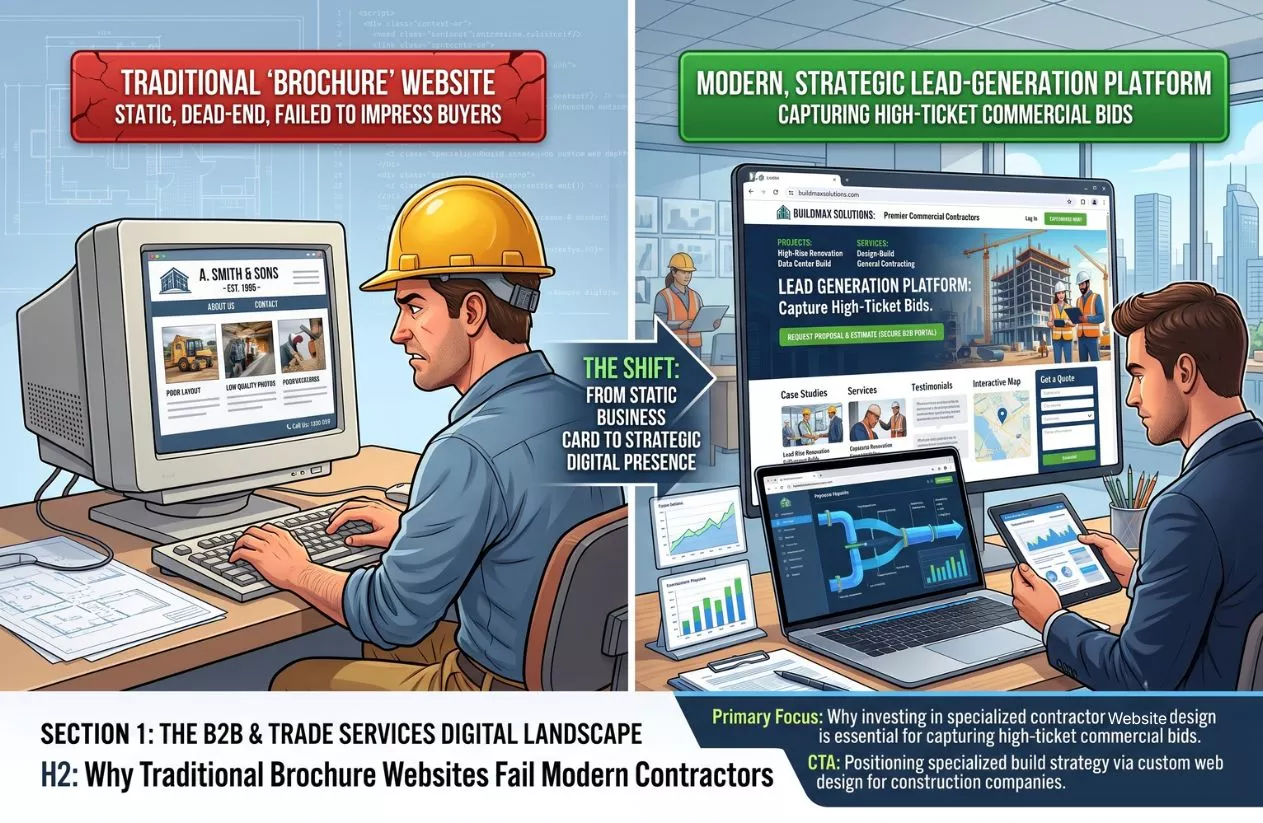
Why Traditional Brochure Websites Fail Modern Contractors
For years, trade businesses relied on simple “brochure” websites—basic multi-page sites with a short generic description, a stock photo of a hard hat, and a phone number. In a competitive B2B market, this passive setup fails to convert high-value visitors.
A basic digital business card does not give a commercial project manager the technical information required to approve a vendor.
When your site lacks deep project documentation, clear safety records, and specific trade qualifications, it creates friction in the buyer’s evaluation process.
+———————————————————————–+
| PASSIVE BROCHURE SITE (Fails B2B Buyers) |
| Generic text -> Stock photos -> No technical proof -> Lost RFP bids |
+———————————————————————–+
+———————————————————————–+
| HIGH-CONVERTING CONTRACTOR PLATFORM |
| Filterable portfolios -> Compliance docs -> RFP portals -> Qualified leads |
+———————————————————————–+
The Shift in How B2B Buyers Vet Contractors
Commercial buyers operate under strict timelines and liability constraints. When vetting trade partners online, they evaluate specific operational markers:
- Proof of Capacity: Can your crew handle a $2M+ commercial build, or are you primarily set up for small residential jobs?
- Risk & Compliance Verification: Is your bonding capacity, OSHA compliance, and liability coverage clearly communicated upfront?
- Geographic & Sector Relevance: Have you successfully executed projects in their specific municipality or building type (e.g., healthcare, cold storage, multi-family)?
If your site forces a busy procurement manager to hunt through generic text to answer these fundamental questions, they will simply click back to the search results.
Transitioning to an Active Lead-Generation Platform
High-performing websites function as an initial pre-qualification layer for your sales and estimating team. Instead of receiving low-quality, out-of-scope inquiries, an optimized platform attracts, educates, and qualifies high-value commercial accounts automatically.
This strategic transformation requires moving beyond static templates. Investing in specialized contractor website design allows you to structure custom bid-request workflows, integrate interactive project maps, and showcase granular case studies that instill instant confidence in commercial decision-makers.
Ready to upgrade your firm’s online footprint? Discover how our targeted web design for construction companies creates high-converting digital platforms engineered to win high-ticket contracts.
Core Conversion Architecture for General Contractors
Winning bids and securing high-value contracts depends on how quickly a website answers two critical questions for a prospective client: Can this company handle my project scale? and How fast can I get a qualified estimate?
If a site structure is confusing or hides essential business details behind bloated pages, visitors leave before submitting an inquiry. Designing a platform for conversion means arranging layout, trust signals, and entry points so commercial buyers and residential clients find exactly what they need in seconds.
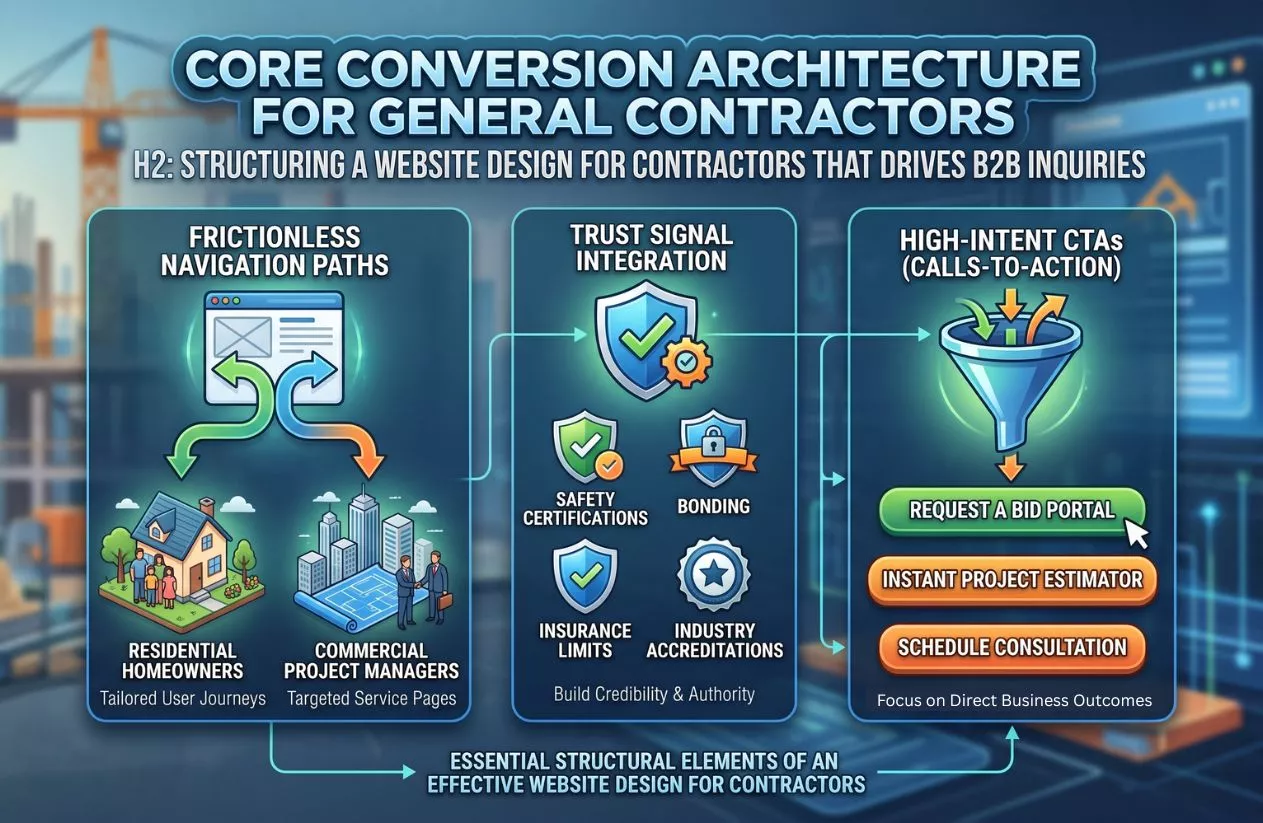
Structuring a Website Design for Contractors That Drives B2B Inquiries
An effective website design for contractors balances clear technical information with a frictionless user path. Commercial decision-makers do not browse sites the same way residential homeowners do.
A project manager looking for a commercial framing partner cares about safety records and bonding capacity, whereas a homeowner planning a custom build focuses on aesthetic finishes and floor plans.
Meeting both needs requires an intentional information structure that separates these audiences immediately upon landing on the homepage.
HOMEPAGE AUDIENCE SPLIT
│
┌─────────────────────────┴─────────────────────────┐
▼ ▼
[Commercial & B2B Portal] [Residential Services]
├── Safety & Bonding Docs ├── Visual Project Galleries
├── Subcontractor Prequal ├── Floor Plan Downloads
└── Direct RFP Submission └── Consultation Scheduler
Dual-Path Information Architecture
To prevent audience overlap and user drop-off, clear primary navigation pathways must guide distinct buyer personas:
- Commercial & Industrial Portal: Dedicated routes featuring downloadable safety sheets, bonding limits, active trade certifications, and a direct RFP submission portal.
- Residential & Custom Build Portal: Focused paths highlighting visual galleries, material selection guides, client testimonials, and simple discovery call scheduling.
Dividing audience flows right on the homepage ensures that commercial buyers are not forced to dig through residential portfolio photos just to evaluate your firm’s commercial capacity.
Prominent Trust Signal Integration
Commercial procurement officers prioritize risk mitigation above all else. Before adding your firm to a bid list, they need confirmation that your business meets strict industry standards and legal requirements.
Integrating key trust signals directly into your site’s header, footer, and individual project pages builds instant credibility:
- Bonding & Insurance Thresholds: Displaying active bonding limits and general liability coverage amounts confirms project capacity upfront.
- Safety Records & Certifications: Prominently placing OSHA compliance stats, EMR ratings, and specialized safety certifications (e.g., USGBC, LEED, ISO) verifies operational discipline.
- Industry Accreditations & Licenses: Displaying state license numbers, AGC, or ABC membership badges assures buyers of verified trade standing.
High-Intent Calls-to-Action (CTAs)
Generic “Contact Us” or “Submit Inquiry” buttons yield low conversion rates because they give prospective clients no clear expectation of what happens next. Replacing vague forms with dedicated, high-intent action pathways dramatically increases qualified inquiries.
+———————————————————————–+
| WEAK CONVERSION FLOW |
| “Contact Us” -> Generic Form -> Unqualified Leads & Long Response Time |
+———————————————————————–+
+———————————————————————–+
| HIGH-INTENT CONVERSION FLOW |
| “Submit RFP / Plans” -> Direct File Upload -> Pre-Qualified Bid Lead |
+———————————————————————–+
High-performing conversion elements move visitors directly into your sales pipeline:
- RFP & Blueprint Upload Portals: Allowing commercial estimators to attach digital plans, CAD files, or project spec sheets directly to their inquiry speeds up bid review.
- Interactive Scope Estimators: Step-by-step tools for residential clients to outline project parameters, timeline expectations, and budget ranges before booking a call.
- Direct Calendar Scheduling: Integrated calendar booking for initial site walks, pre-con meetings, or trade consultations—eliminating back-and-forth emails.
Visual Proof & Interactive Portfolio Strategy
In the construction and trade industries, claims of quality mean very little without concrete visual evidence. Commercial project managers, architects, and property developers will not award a high-value contract based on written promises alone.
They require verifiable proof that your field teams deliver on time, adhere to strict architectural specs, and maintain clean, safe job sites.
Transforming a basic photo gallery into a strategic visual proof engine provides the undeniable evidence needed to win competitive bids.
Building Digital Portfolios for Construction and Specialty Trades
An effective portfolio goes far beyond posting static thumbnail photos. To convert high-intent prospective buyers, your portfolio must showcase craftsmanship, technical complexity, and project scale across every stage of the build cycle.
A modern trade portfolio utilizes high-resolution media and interactive elements to bring job sites to life, letting potential clients inspect your work long before a physical site visit.
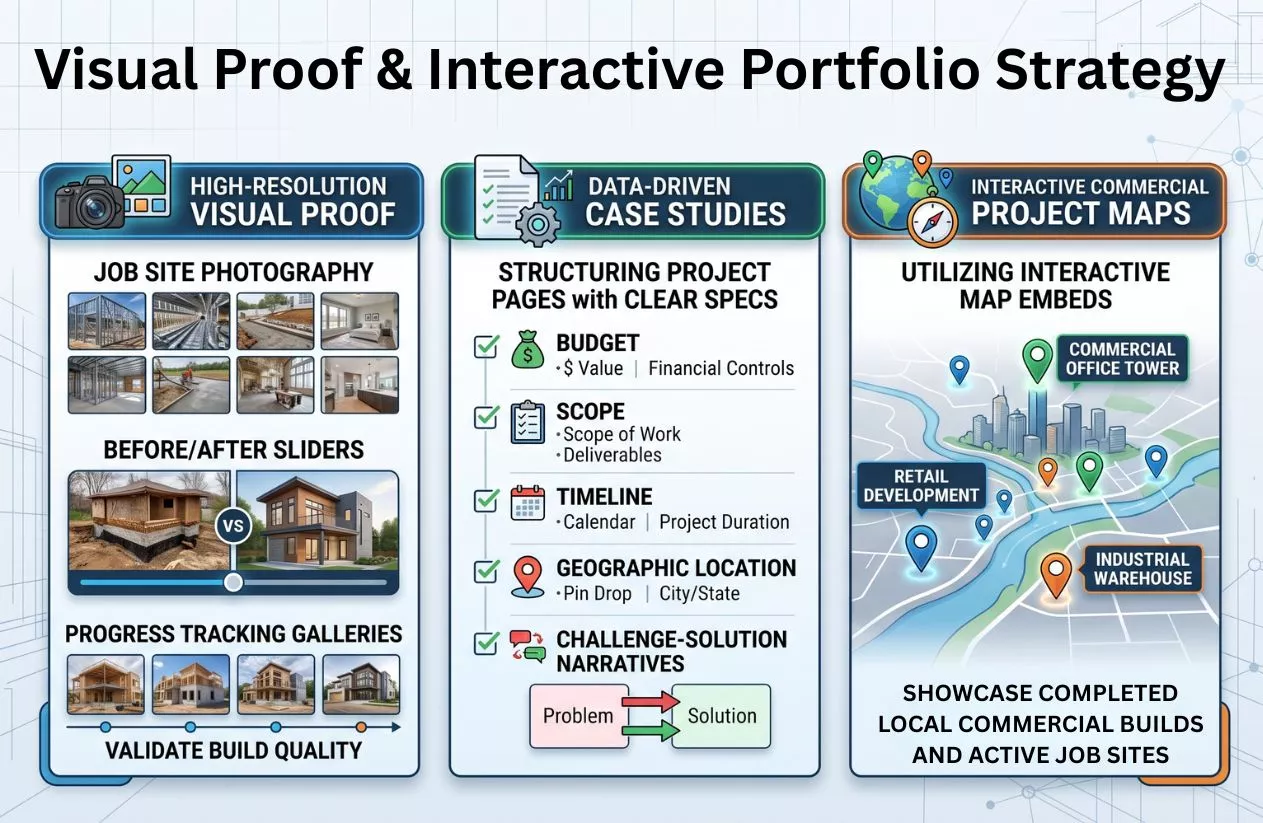
High-Resolution Visual Proof & Field Progress Tracking
Stock photography instantly destroys credibility on a trade website. Commercial buyers recognize generic imagery immediately, which signals a lack of real project experience.
Authentic, high-resolution photography and media from actual job sites build immediate trust.
+———————————————————————–+
| WEAK VISUAL PRESENTATION |
| Generic Stock Photos -> Unorganized Grid -> Zero Context -> High Bounce|
+———————————————————————–+
+———————————————————————–+
| HIGH-IMPACT PROOF ARCHITECTURE |
| Drone Aerials -> Interactive Before/After -> In-Progress Site Specs |
+———————————————————————–+
High-converting visual presentation strategies include:
- Interactive Before/After Sliders: Essential for renovation, adaptive reuse, and structural repair projects. Sliders allow clients to physically drag across photos to see exact transformation results.
- Drone Aerial Photography & Videography: High-angle site footage highlights project scope, ground preparation quality, and massive structural frameworks for large commercial and industrial developments.
- In-Progress Milestone Tracking: Including step-by-step progress galleries demonstrates site safety, clean staging, structural framing, and specialized trade coordination before the drywall goes up.
Data-Driven Case Studies That Win Bids
A photo shows what a build looks like, but a data-driven case study explains how your firm solves complex engineering and logistical challenges. Structuring project pages around hard data transforms simple galleries into compelling sales assets.
Every major project case study should present clear, structured metadata:
| Project Data Spec | Strategic Value for B2B Buyers |
| Project Scope & Trade Role | Clarifies exact responsibilities (e.g., Prime Contractor, Subcontractor, Design-Build partner). |
| Budget & Financial Scale | Validates financial capacity and experience handling projects of similar monetary value. |
| Timeline & Delivery Metrics | Proves ability to meet strict schedule deadlines and complete phases on time. |
| Square Footage & Building Type | Demonstrates specific sector familiarity (e.g., 45,000 sq ft medical office, tilt-up warehouse). |
| Challenge-Solution Narrative | Details how your team overcame site constraints, supply chain delays, or complex structural retrofits. |
Interactive Commercial Project Maps
Commercial buyers prefer working with contractors who have deep local experience and established relationships with regional planning departments, inspectors, and material suppliers.
Integrating an interactive project map on your portfolio page visually proves your geographic footprint and density of successful builds:
┌────────────────────────────────────────┐
| INTERACTIVE REGIONAL PROJECT MAP |
| |
| [ Pin: Industrial Warehouse ] [ Pin: Healthcare Facility ] |
| (Completed) (Active Build) |
| |
| [ Pin: Commercial Plaza ] |
| (Completed) |
└────────────────────────────────────────┘
- Filterable Map Pins: Users can filter active and completed job sites by industry type (retail, healthcare, industrial, multi-family) or service line.
- Job Site Quick Cards: Clicking a map pin displays a preview card with a project photo, brief scope summary, completion date, and a direct link to the full case study.
- Local Market Authority: Seeing dozens of completed projects across a target metropolitan area reassures local procurement teams that your crews are established and proven in their market.
Advanced Features for General Contractor Website Design
A general contractor’s website needs to serve more than just prospective clients. On any given workday, field superintendents, architects, subcontractors, material suppliers, and safety inspectors interact with your web platform.
Integrating targeted operational features into your general contractor website design turns your site into a centralized hub that improves communication, speeds up bid submissions, and supports daily job site operations.
Tailoring Features for General Contractors & B2B Trades
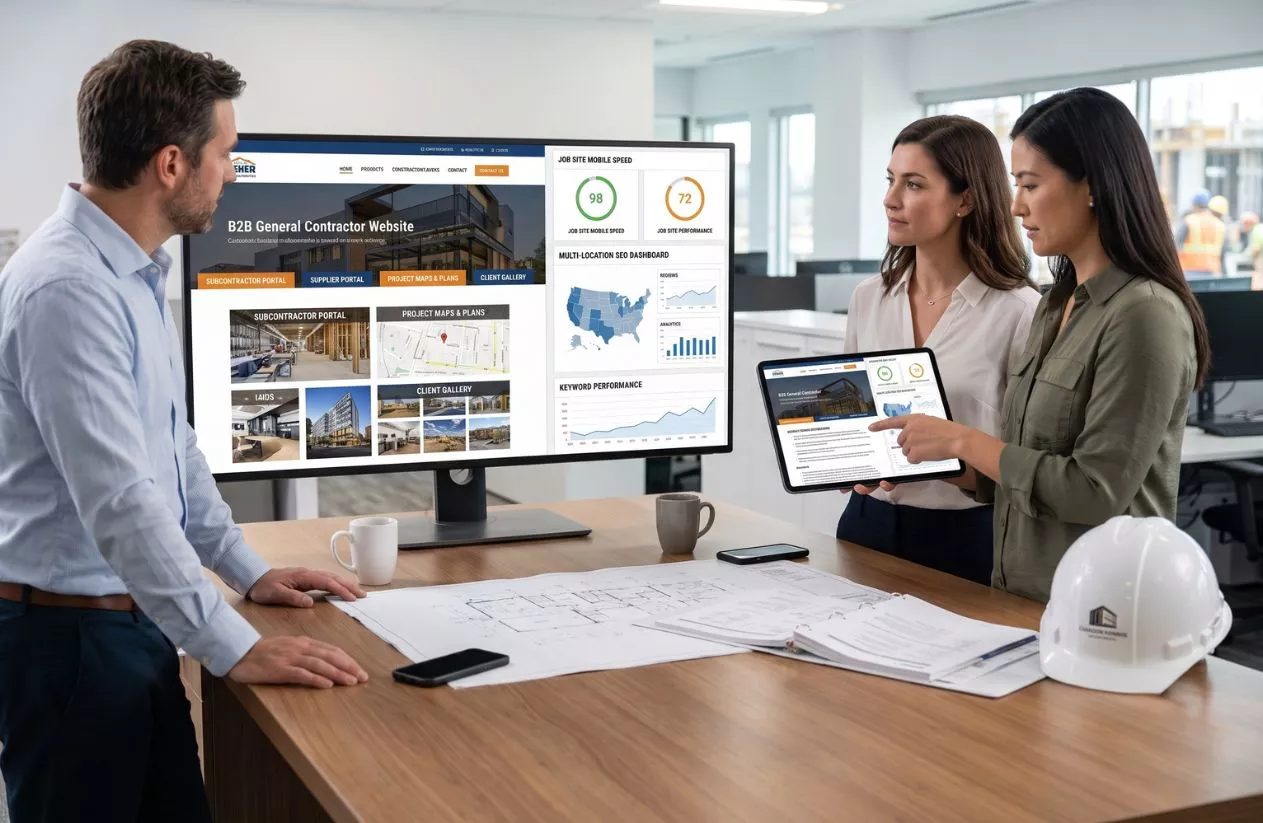
Building a site for commercial contracting requires functionality that goes far beyond basic contact forms and static photo galleries.
Modern web architecture provides the backend tools necessary to manage high-volume file transfers, deliver instant job site access on mobile devices, and capture localized search traffic across multiple service territories.
Dedicated Subcontractor & Supplier Portals
Mixing client-facing sales messaging with internal vendor management creates confusion for both audiences. Implementing a dedicated partner portal separates marketing content from operational workflows.
┌───────────────────────────────────────────────────────────────────────┐
| CENTRAL SITE ARCHITECTURE |
└──────────────────────────────────┬────────────────────────────────────┘
│
┌─────────────────────────┴─────────────────────────┐
▼ ▼
[Public Client Portal] [Trade Partner Portal]
├── Project Showcases ├── Plan Room & Specs
├── Service Capabilities ├── Prequalification Forms
└── Direct RFP Engine └── Subcontractor Bids
A streamlined trade portal delivers clear operational benefits:
- Digital Plan Rooms: Provides password-protected access where subcontractors can view architectural blueprints, scope documents, and addenda for upcoming bids.
- Subcontractor Prequalification: Streamlines vendor onboarding by collecting tax forms, safety records, and insurance certificates directly through secure web forms.
- Vendor Bid Submissions: Allows trade partners to submit line-item estimates and scope proposals directly to your estimating team, keeping bid files organized by project.
Field Performance: Mobile Speed on the Job Site
Project managers, architects, and field engineers often pull up your website while standing on an active job site, using mobile devices connected to variable cellular networks.
If your site takes ten seconds to render heavy image galleries or download project specs, field productivity stalls.
Optimizing mobile performance for field conditions requires strict technical practices:
- Next-Gen Image Formats: Converting heavy photographic files into high-efficiency formats like WebP or AVIF reduces image payload sizes by up to 70% without sacrificing visual clarity.
- Responsive Image Scaling & Lazy Loading: Serving scaled images matched to the user’s screen resolution ensures mobile phones do not waste bandwidth downloading desktop-sized files. Deferring off-screen images until a user scrolls down further improves initial page render speeds.
- Aggressive Code Splitting: Minimizing unused CSS and JavaScript keeps render times under two seconds, even over weak cellular connections in the field.
Local SEO Infrastructure for Service Area Dominance
Commercial buyers and property developers frequently search for regional contractors using geo-targeted queries (e.g., “commercial framing contractor in [City]”). A single, generic contact page is not enough to rank across multiple municipalities or regional markets.
Building out a multi-location SEO framework secures search visibility across your entire operational footprint:
+———————————————————————–+
| GEOGRAPHIC SEARCH STRUCTURE |
+———————————————————————–+
| Core Domain (Domain.com) |
| ├── /locations/city-a/ (Custom Projects + Local Testimonials) |
| ├── /locations/city-b/ (Custom Projects + Local Testimonials) |
| └── /locations/city-c/ (Custom Projects + Local Testimonials) |
+———————————————————————–+
- Location-Specific Service Pages: Dedicated landing pages for each major city or county you serve, highlighting localized project case studies, client testimonials, and regional office contact info.
- Embedded Google Maps & Schema Markup: Structured LocalBusiness schema data communicates your exact service boundaries, business address, and licenses directly to search engine crawlers.
- Targeted Service-Location Keywords: Naturally integrating localized commercial search terms ensures your firm appears when local developers and project managers search for qualified regional builders.
Selecting the Right Development Partner
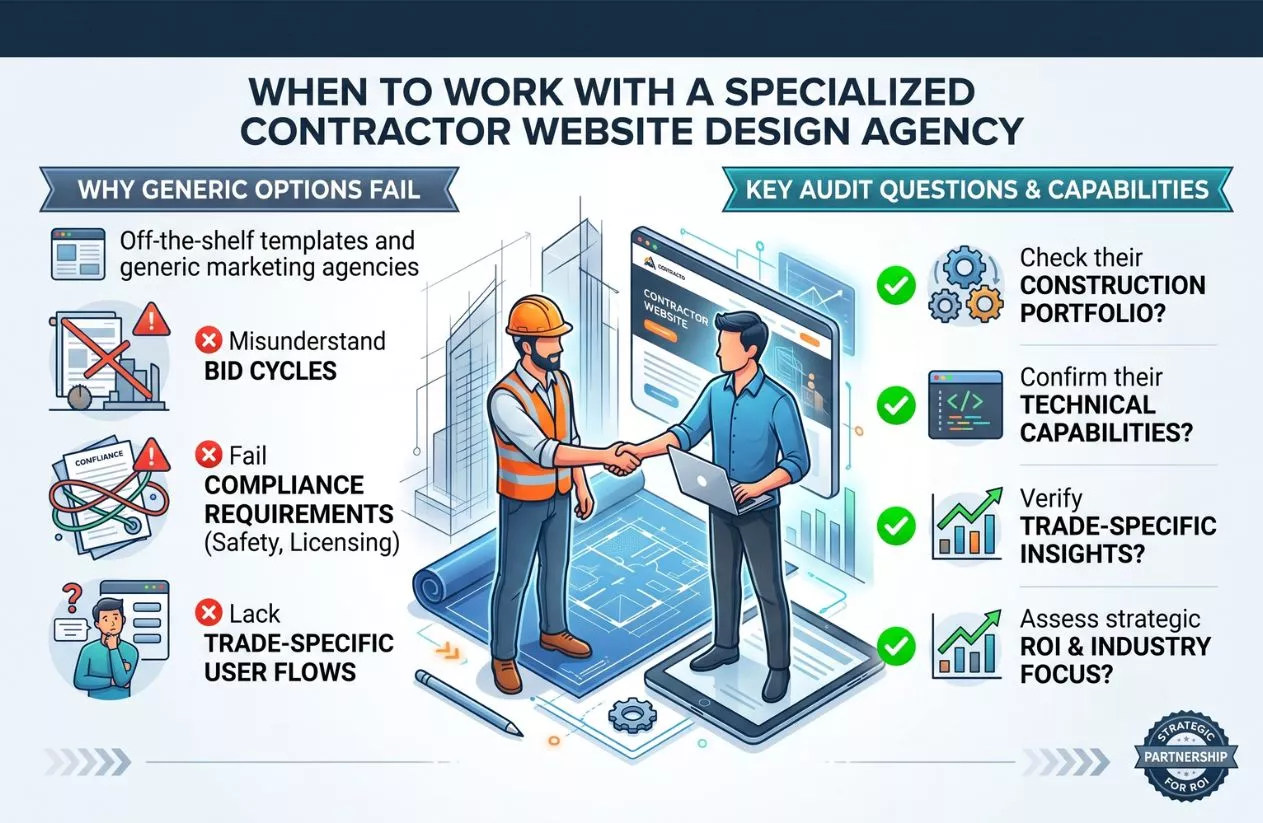
Building a site that functions as a high-volume sales engine requires more than basic coding skills or aesthetic design talent. It demands a deep understanding of how commercial contracts are awarded, how procurement teams evaluate risk, and how trade operational data flows between field teams and backend offices.
Choosing the wrong development partner often leads to missed project deadlines, generic visual branding, and a platform that fails to generate qualified bids.
When to Work with a Specialized Contractor Website Design Agency
General web design agencies and off-the-shelf site builders cater primarily to retail, e-commerce, or consumer-facing businesses. While a template might look visually appealing, it lacks the technical architecture required to handle commercial plan rooms, trade compliance documentation, or complex multi-tiered buyer journeys.
Partnering with a specialized contractor website design agency ensures your digital infrastructure is engineered around the actual economics and operational realities of the construction industry.
+———————————————————————–+
| GENERIC MARKETING AGENCY APPROACH |
| Consumer Templates -> Stock Photos -> Generic Forms -> Missed Bids |
+———————————————————————–+
+———————————————————————–+
| SPECIALIZED CONTRACTOR AGENCY APPROACH |
| Plan Rooms -> Compliance Badges -> Dual Funnels -> Qualified Leads |
+———————————————————————–+
Why Generic Agencies and Off-the-Shelf Templates Fail
Consumer-focused web design models break down when applied to high-value commercial contracting:
- Ignorance of Long Bid Cycles: Generic agencies build for instant impulse transactions. They do not account for 3-to-12 month commercial sales cycles that require downloadable capability statements, project milestone tracking, and multi-stakeholder approval flows.
- Inability to Structure Compliance Signals: Off-the-shelf themes do not have built-in frameworks for displaying EMR safety ratings, OSHA logs, bonding capacities, or union affiliations—the exact metrics commercial buyers check first.
- Poor File Handling for Plans & Blueprints: Standard contact forms choke when visitors try to attach multi-page CAD drawings, massive PDF spec packages, or site plans. Specialized trade platforms integrate dedicated, secure upload streams built for heavy technical documents.
Vetting a Web Development Team: Essential Audit Questions
To protect your capital investment, audit prospective agencies using questions tailored to B2B trade requirements rather than generic marketing metrics:
┌───────────────────────────────────────────────────────────────────────┐
| AGENCY EVALUATION CHECKLIST |
└──────────────────────────────────┬────────────────────────────────────┘
│
┌─────────────────────────────┼─────────────────────────────┐
▼ ▼ ▼
[Industry Expertise] [Technical Build] [Post-Launch ROI]
├── Trade Case Studies ├── Security & Access ├── Maintenance SLAs
└── Portfolio Audits └── Blueprint Uploads └── Lead Tracking
Before signing a contract, require prospective partners to answer these core operational questions:
- Portfolio & Trade Alignment: “Can you show us three live B2B or commercial trade platforms you built that handle complex, multi-million dollar project portfolios?”
- Document Management: “How does your form architecture process high-volume, multi-gigabyte blueprint and RFP file uploads without slowing down server execution?”
- Audience Segmentation Capabilities: “How will your proposed information architecture separate our residential prospective clients from commercial project engineers on the homepage?”
- Maintenance & Security SLAs: “What post-launch protocols do you offer to keep database queries fast, backup files isolated offsite, and core application files secure from malware?”
Calculating Strategic ROI from a Dedicated Partner
Treating website development as a one-off overhead expense is a mistake. Working with a dedicated contractor website design agency yields a direct return on investment by systematically eliminating sales friction.
Winning a single additional commercial bid or high-ticket custom build as a direct result of an authoritative digital portfolio can cover the entire cost of a custom web project many times over.
An optimized website pays for itself by automating lead pre-qualification, increasing bid accuracy, and presenting your firm as the premier, low-risk choice in your regional market.
Related Article: How Denver Businesses Can Outrank National Competitors Using Localized Web Design
Transforming Your Website Into Your Top-Performing Estimator
A contractor’s website should never sit idle as a forgotten digital business card. When structured with intentional user flows, deep project proof, and clear technical compliance signals, your site becomes an active, 24/7 sales engine that pre-qualifies incoming bids, builds instant credibility with procurement officers, and keeps your estimating queue filled with high-margin opportunities.
Transitioning from a passive brochure to a high-converting digital platform eliminates friction for commercial buyers and secures your firm’s position as a premier trade partner.
Actionable Next Step: The 5-Point Portfolio & Funnel Audit
Before rebuilding your site or investing in new digital campaigns, run your current online presence through this targeted 5-point audit to identify conversion bottlenecks and missed bid opportunities:
- Evaluate Portfolio Depth & Metadata: Do your project pages show real, high-resolution job site photography paired with hard specs (budget scale, timeline execution, building type, and trade scope), or are you relying on unorganized thumbnail grids and stock photos?
- Test Mobile Load Speeds for Field Users: Open your primary project galleries on a mobile device over a 4G/5G connection. Does the page render in under two seconds, or do uncompressed images stall site performance for project managers in the field?
- Audit High-Intent Conversion Pathways: Can a commercial project engineer upload a multi-page PDF spec sheet or blueprint package directly from your site, or are they forced to send an unformatted email to a generic inbox?
- Verify Upfront Compliance & Trust Signals: Are your bonding thresholds, safety records (EMR/OSHA ratings), trade licenses, and industry accreditations visible on primary landing pages, or are they hidden in obscure footers?
- Review Audience Segmentation: Does your homepage immediately separate residential custom build inquiries from commercial B2B procurement flows, or are commercial buyers forced to hunt through residential content?
Build Your High-Converting Digital Engine
Stop letting out-of-date web templates and missing technical proof cost your business valuable commercial bids. Position your firm for sustained growth with a custom digital platform built specifically for trade professionals.
Ready to transform your site into your top-performing lead generation asset? Schedule a custom project strategy session today through our specialized web design for construction companies team.
Related Article: 7 Must-Have Features for Construction Websites

